The Logistics Behind Ration Distribution: How Saylani Reaches Remote Areas
Blog Posted On: December, 16, 2025
In a country such as Pakistan, where it is geographically diverse and economically uneven, making sure that food is accessible to the underprivileged community is a big challenge. Remote villages in Balochistan, mountainous regions in Gilgit Baltistan, flood-prone districts in Sindh, and most of the time stay unconnected with relief efforts. Despite all of these things and challenges, Saylani Welfare International Trust has built the most organized, efficient, and far-reaching Saylani Ration Support compared to any other non-governmental organization in Pakistan.
Why does Reaching the Remote Areas Matter?
Access to food is limited in most remote areas, which is why food insecurity hits them the hardest. Unlike the urban areas where it is easy to access markets, wifi, transport and employment as compared to rural and isolated areas that often struggles with all kinds of problems like lack of opportunities, Seasonal crop failures, High transport cost, Limited access to healthcare and clean water, Natural disasters causing problems like cutting off roads access which cause severe issues and unpredictable weather conditions. In these areas, Saylani free meal programthrough Saylani ration support makes a big difference and helps them survive through the hunger period. Saylani recognized the hardships of these people and the urgency of this matter, which is why it is trying to make remote-area outreach a priority of one of its humanitarian works with your food donation .
How Saylani Identifies Who Needs Help?
The logistic process began long before the start of Saylani Ration Support Packaging. Saylani heavily relies on a structured assessment system to determine who needs the help of Saylani the most at that moment. So, Saylani can actually reach those who really need it. This planning process has many different stages as follows:
1. Different Ways of Data Collection
Ground Surveys and Local Committees
Saylani volunteers and coordinates travel to many different locations, like Desert villages, Flood-affected districts, Mountain communities, and Low-income rural settlements. They also conduct surveys, visit homes, and meet local elders to identify Household size, Income level, Employment status, and Number of widows, elderly, and disabled persons. This ground-level approach ensures that Saylani ration support is reached by the right people at the correct time.
Collaboration With Local Leaders
Community representatives, school teachers, mosque imams, and village elders provide essential insights on which families are really poor and require help, which areas need urgent distribution of rations, and what transportation method would be most suitable to deliver food donation to these people with ease or fewer challenges. This kind of collaboration helps both the community and Saylani by avoiding duplication and ensuring fair distribution of supplies.
Digital Data Collection
Saylani not only uses personal methods and collaboration methods to know about people who need these ration supplies, but they also use digital data collection methods. Saylani increasingly uses mobile apps, digital survey tools, and GPS mapping to collect data through advanced technology. These methods help them centralize data. plan easy routes to transfer supplies, allocate resources, and avoid missing any isolated households that require these food supplies.
Non-governmental organization in Pakistan, like SWIT, are putting a great effort into their humanitarian work to help those who really need it with the help of your donations and volunteer work, without which none of it is actually possible.
2. Preparing the Ration Bags
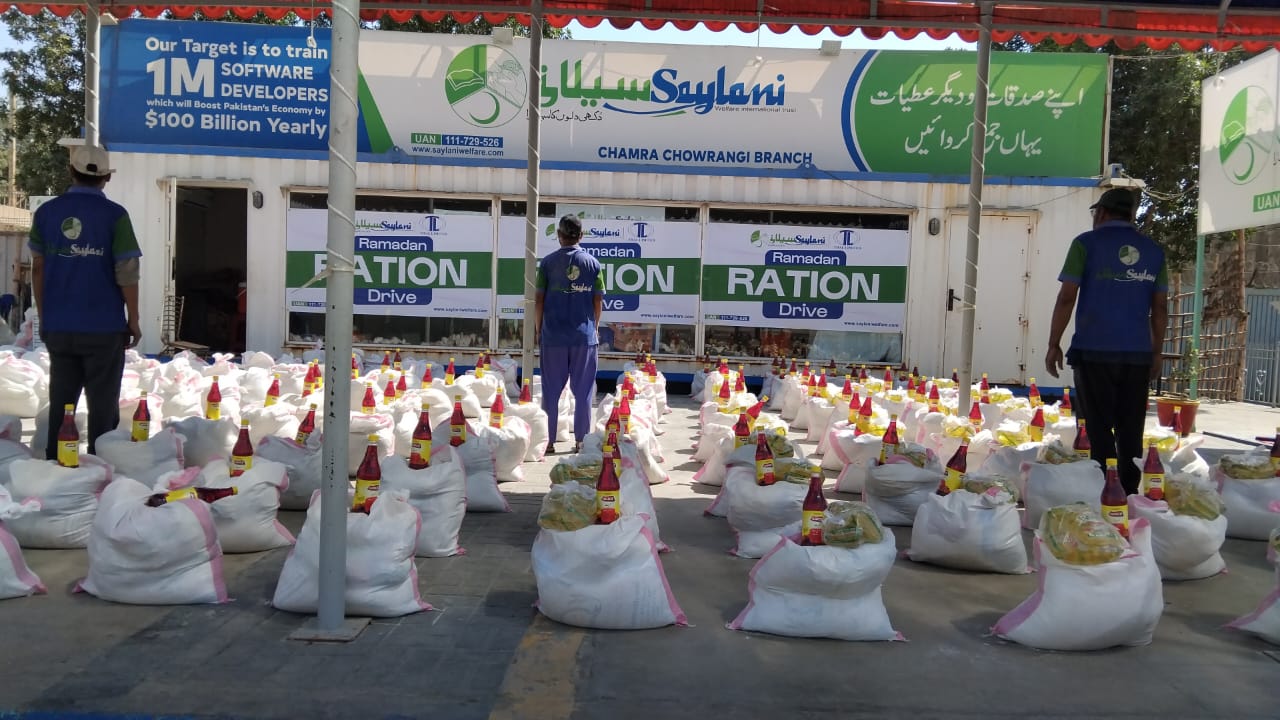
Once the people who need ration bags are identified, after that comes the step of ration bag preparation, which is done at Saylani's central warehouses and food storage facilities by volunteers and staff members of Saylani. It's a combined effort to make this initiative successful by people and Saylani.
What is inside the standard Raion bag provided by Saylani?
The supplies in ration bags vary for different regions and also according to the needs of people, but the standard bags contain 10–20 kg flour, Rice, Pulses, Sugar, Tea, Oil or ghee, Salt, Spices, Soap, and Biscuits or nutritional supplements. As for the disaster zone area, some additional things like water bottles, ORS, baby food, blankets, or hygiene kits are required according to the situation.
Bulk Procurement for Cost Efficiency
To minimize the cost of bulky supplies. Saylani directly takes supplies from Trusted wholesalers, Mills, and Manufacturers. Also, bulk buying reduces the cost per unit, ensures consistent quality, and allows predictable planning for large-scale distributions.
Packaging and Quality Checks
Warehouse staff check the weight, sealing, and quality control of these bags through different methods. They check everything from the freshness of food to the sealing process.
3. Transportation
Transportation is the most important part of the whole journey and also the most difficult part of it. Transporting these Saylani ration support uses multiple modes of transport depending on the area they are passing through. Trucks are used for major routes, Jeeps and 4x4 Vehicles for Mountainous or Desert Terrain, Boats and Rafts in Flood-Prone Areas, Motorcycles for Narrow or Unstable Paths, and lastly, Donkey Carts or Local Transport are used for deep in rural or mountainous regions.
4. Distribution Points
After transportation, the last part of the distribution is done. Distribution is also done through different methods, like setting up camps from where people come and take supplies. Door-to-door services are also provided to isolated homes. These supplies are not distributed without any verification. Verification is also an important step of the process at the time of distribution. In case of natural disasters, emergency response teams are deployed by Saylani.
Read More blogs
